Done Right
Appliance Repair
📞 Call Now
Appliance Repair
We are an appliance repair company. Our business depends on doing repairs. So when we tell a customer "don't repair it — replace it," we mean it.
This happens more often than you might think. Not every broken appliance is worth fixing, and we would rather give you an honest assessment and lose a job than take your money on a repair that will not solve the problem long-term. Here are the real situations where we recommend replacement over repair — and why.
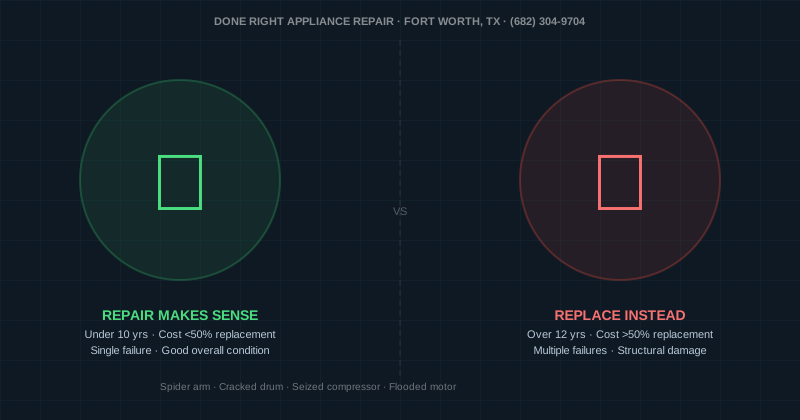
Our general rule: If the repair costs more than 50% of what a comparable new appliance costs, and the machine is over 10 years old, replacement is usually the smarter financial decision. But there are specific situations where we recommend replacement regardless of cost — because some failures mean the machine's structural life is over.
The dryer drum is the large metal cylinder that tumbles your clothes. It can crack along the seam, develop holes from prolonged heat stress, or in some cases shatter from impact with a forgotten item left in a pocket.
A cracked drum is not just cosmetic — clothing catches on the crack, tears happen, and small holes allow clothes to get sucked into the heating element area. It's also a fire hazard if lint accumulates near the heating element through a crack.
Why we often say don't repair: A replacement drum typically costs $180–$350 in parts alone, plus 2–3 hours of labor. On a dryer that's 10+ years old, you're spending $350–$500+ to extend the life of a machine that may have other aging components ready to fail. In many cases, a new mid-range dryer makes more financial sense.
Exception: If the dryer is relatively new (under 6 years), drum replacement can absolutely make sense — you still have many years of life ahead. We'll tell you honestly based on the specific model and age.
The spider arm — also called the drum support bracket or drum spider — is the three-legged metal component that connects the inner drum to the rear bearing and drive shaft on front-load washers. It's essentially the spine of the washing machine's drum assembly.
When the spider arm cracks or breaks, the drum loses its support and starts wobbling violently. You'll hear severe banging during the spin cycle, the machine may walk across the floor, and in advanced cases the drum can grind against the drum seal and tub walls.
Signs of a failed spider arm: Loud banging during spin, drum that moves side to side when you push it by hand, machine failing to reach spin speed, error codes related to imbalance (UE, E3, F5).
Why we often say don't repair: Spider arm replacement on most front-loaders requires near-complete disassembly — removing the drum, rear bearing, and shaft. Parts cost $80–$200. Labor is 3–5 hours. Total repair often runs $350–$600. On a washer that's already 10+ years old — especially LG or Samsung models where spider arm failure is a known aging issue — you're investing heavily in an old machine. We see this repair frequently and our honest advice is usually to put that money toward a new washer.
Exception: High-end washers (Speed Queen, Miele, Bosch 500 series) are often worth the repair because of their superior build quality and longer overall lifespan.
The compressor is the heart of your refrigerator — the pump that circulates refrigerant through the sealed system to create cold. When a compressor seizes, it makes a loud click or hum and then goes silent as it trips the overload protector. The fridge stops cooling entirely.
Compressor replacement is expensive — the part alone runs $200–$600 depending on the brand, and labor adds another $150–$300. Whether it makes sense depends heavily on the age of the refrigerator and the brand.
Our approach: We diagnose the compressor and check the condition of the rest of the sealed system before giving you a recommendation. If the evaporator coils, condenser, and refrigerant lines look healthy, compressor replacement is often a great repair. If we see signs of broader system aging, we'll tell you — and explain exactly why.
Front-load washers have a rubber door boot seal — the accordion-shaped gasket that creates a watertight seal between the door and the drum. When this seal tears or develops mold damage, water leaks into the machine's lower cabinet during every wash cycle.
A fresh door boot seal failure is a straightforward $150–$200 repair. But when a seal has been leaking for months unnoticed — which happens more often than you'd expect — water finds its way into the motor, the main bearing housing, and the wiring harness. At that point, you're looking at cascading failures.
Why we sometimes say don't repair: When we open the machine and find evidence of prolonged water intrusion — rust on the bearing housing, corroded wiring, water marks on the motor — the seal is just the beginning. Bearing replacement alone adds $200–$350 to the job, and corroded wiring creates unpredictable electrical failures down the road. On an older machine, we tell customers this honestly before proceeding.
Most dishwashers have a plastic inner tub. Over years of thermal cycling — heating up and cooling down with every wash cycle — plastic becomes brittle. Cracks develop along stress points, usually at the bottom corners of the tub or around the pump housing.
A cracked dishwasher tub means water leaking onto your floor every time the dishwasher runs. There is no practical repair for a cracked tub — the part is not sold separately, and even if it were, replacement would require near-complete disassembly.
Our advice: Replace. A cracked tub is end-of-life for that dishwasher. Stainless-steel tub dishwashers (most Bosch models, higher-end GE, KitchenAid) don't have this problem — which is one reason they cost more upfront but last significantly longer.
Occasionally we open an oven and find significant burn damage to the wiring harness — the bundle of electrical cables that connects all the oven's components. This happens after a grease fire inside the oven, an electrical arc from a failing heating element, or after severe self-clean cycle damage.
Wiring harness replacement is expensive and time-consuming. But the bigger concern is safety — an oven that has experienced significant electrical burning has compromised insulation throughout the system. Even after repair, we cannot guarantee that all affected wiring has been identified and addressed.
Our advice: For safety reasons, we recommend replacement in most cases of significant fire or burn damage. This is not a situation where we want to fix what we can see and hope the rest holds up.
We have seen what happens when a customer gets talked into an expensive repair on a machine that wasn't worth saving. They pay $400, the machine breaks again two months later, they're frustrated, and they never call that technician again. And they tell their neighbors.
We'd rather tell you the truth, lose the repair job, and have you call us next time — whether it's for a repair that does make sense, a second opinion, or just because you trust us enough to recommend us to someone else.
That is the whole point of being a local business. Our reputation in Fort Worth and Keller is worth more than any single repair invoice.
Call us. We'll give you an honest assessment after diagnosis — no pressure, no upsell. If it's not worth fixing, we'll tell you.
📞 Call (682) 304-9704If the repair costs less than 50% of replacement and the appliance is under 10 years old, repair usually makes sense. Over 12 years old, or with structural damage like a cracked drum or broken spider arm, replacement is often the smarter call. We give you an honest assessment after every diagnostic.
The spider arm is the three-legged metal bracket that connects the drum to the rear bearing and shaft on front-load washers. When it breaks, the drum wobbles severely. Replacement typically costs $350–$600 in parts and labor — on older machines, this often makes replacement more sensible.
In most cases, no — the drum must be replaced. Drum replacement costs $200–$400 in parts plus labor. On an older dryer, this frequently costs more than the machine is worth. We'll tell you honestly based on the specific model and age.
When the compressor has seized on a refrigerator over 12–15 years old, or when there's a sealed system refrigerant leak. Repair costs are high, and other aging components often follow. Modern refrigerators are also 30–40% more energy efficient, which adds to the case for replacement.
Always. We would rather give you an honest answer and lose the repair job than take your money on something that won't last. Our reputation in Fort Worth and Keller matters more than any single invoice.